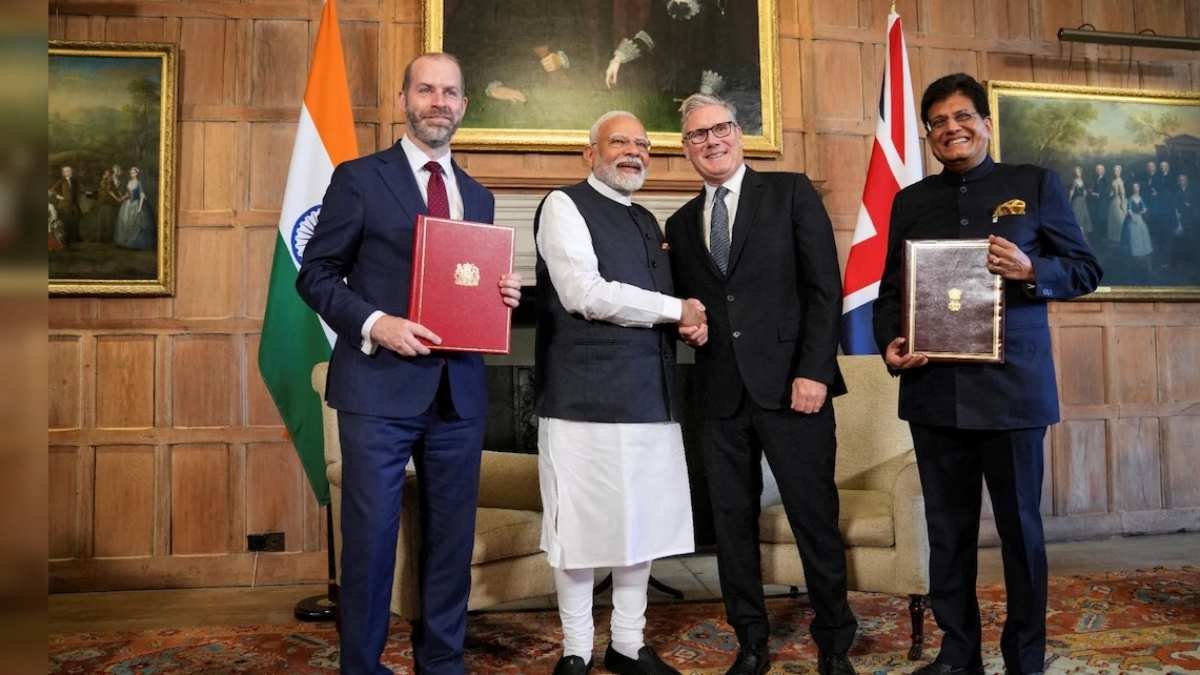
In a landmark moment for global trade relations, Prime Minister Narendra Modi and UK Prime Minister Keir Starmer on Thursday formally signed a long-awaited Free Trade Agreement (FTA) between India and the United Kingdom. The deal, hailed as India’s most comprehensive trade pact and Britain’s most significant post-Brexit economic agreement, is expected to unlock billions in trade and investment for both countries.
The signing took place during PM Modi’s visit to the UK — the first leg of his two-nation tour. Ahead of the formal signing, the two leaders held a bilateral meeting at London’s historic Hawtry Room, where they finalised the contours of the agreement after years of negotiations.
Key Highlights of the India-UK FTA:
- Zero tariffs on 99% of Indian exports to the UK, including key sectors such as textiles, footwear, leather, gems and jewellery.
- Duty-free access on 95% of agricultural products and 99% of marine exports, a major boost for Indian farmers and fisherfolk.
- Greater market access for British exports like whisky, cars, and medical devices in India.
- An estimated £25.5 billion boost to bilateral trade annually, according to the British High Commission.
Speaking at the signing ceremony, PM Modi said,
“Today marks a historic day in our relations. After years of hard work, our two nations have signed a comprehensive economic and trade agreement. This pact will especially benefit Indian youth, farmers, fishermen, and the MSME sector.”
He added that Indian products will gain competitive access in the UK market, while British medical devices and other goods will be available in India at more affordable prices.
Commerce Minister Piyush Goyal described the agreement as a “big win for Indian farmers and fisherfolk,” noting that it ensures duty-free access for nearly all marine exports and the vast majority of agricultural produce.

On the UK side, PM Keir Starmer called the deal a cornerstone of his new government’s trade policy:
“This is the biggest and most economically significant deal the UK has made since leaving the EU. It’s a deal that brings jobs, investment, and growth to both our nations — boosting wages and putting more money in people’s pockets.”
Earlier in the day, Starmer called the trade deal “a Plan for Change in action” and posted on X that it would unlock thousands of jobs in the UK and new business opportunities.
Years in the Making
Formal negotiations for the FTA began in 2022 and were originally targeted to conclude by Diwali that year — a deadline set by then UK Prime Minister Boris Johnson. Despite 13 rounds of talks, a final agreement remained elusive due to political changes in both countries.
Talks were paused in 2024 due to general elections in India and the UK. After PM Modi’s re-election and the Labour Party’s victory under Keir Starmer, the two governments moved swiftly to conclude the agreement.
With the deal now sealed, both nations are poised to redefine their economic partnership and lay the groundwork for a new era of collaboration beyond trade — one that strengthens strategic and cultural ties as well.