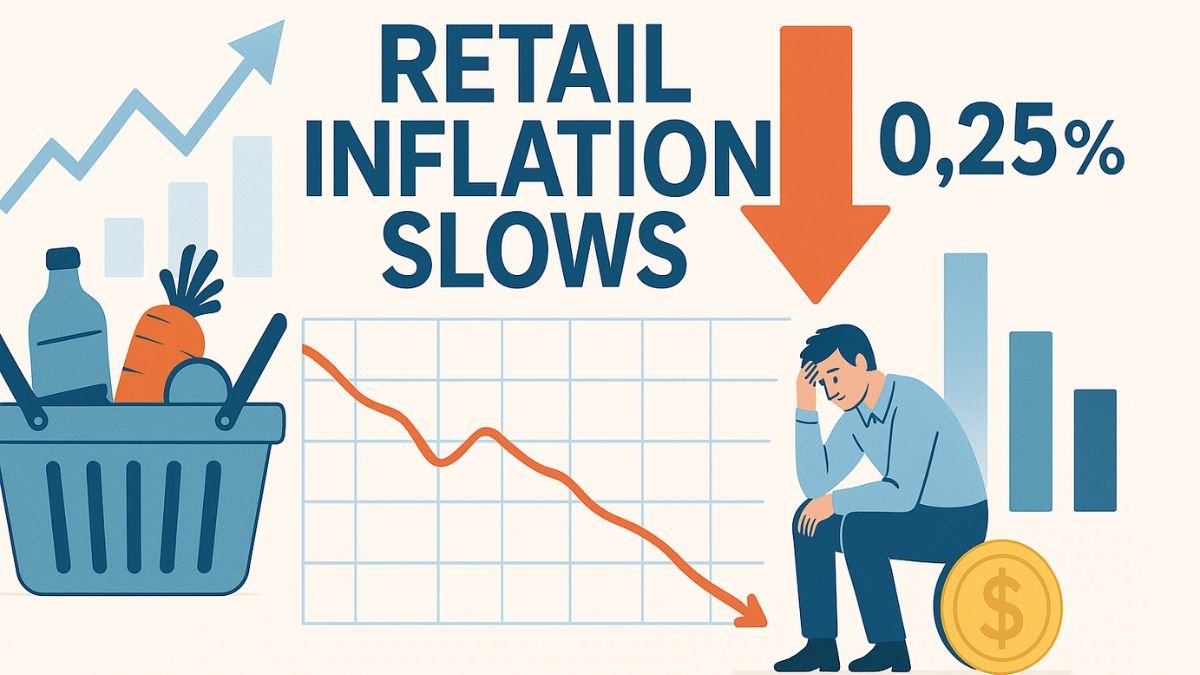
India’s headline retail inflation reached a historic low in October 2025, according to official data released by the government on November 12. Consumer Price Index (CPI)-based inflation dropped to 0.25 % year-on-year, down sharply from 1.54 % in September (revised to 1.44 %).

Key Drivers
- Food inflation — which carries nearly half the weight in the CPI basket — plunged 5.02 % in October, compared with a fall of 2.33 % in September.
- Vegetable prices alone registered a dramatic decline of 27.57 % year-on-year, compared with a 21.38 % fall in September.
- Additional factors included the full-month impact of recent GST rate cuts and a favourable base effect.
- Rural inflation stood at –4.85 % and urban inflation at –5.18 %.
- The fuel & light category inflation was recorded at 1.98 % in October.
Macro-Economic and Policy Implications
- For four consecutive months, inflation has stayed below the Reserve Bank of India’s (RBI) medium-term target of 4 %, and under its tolerance ceiling of 6 % for seven straight months.
- The RBI in its recent Monetary Policy Committee meeting noted that the benign inflation backdrop offered “scope for further policy easing to support growth.”
- The central bank revised its full-year inflation forecast for FY26 down to 2.6 %, compared to 3.1 % in August.
- Quarter-wise estimates: 1.8 % in Q2, 1.8 % in Q3, 4.0 % in Q4, and 4.5 % in Q1 of FY27.
- Quarter-wise estimates: 1.8 % in Q2, 1.8 % in Q3, 4.0 % in Q4, and 4.5 % in Q1 of FY27.
Why This Matters
- Low inflation provides breathing space for consumers, especially since food and vegetables have been the main contributors to price declines.
- For businesses and policymakers, the disinflationary trend raises hopes that the RBI could cut interest rates further to fuel growth, while balancing the risk of demand softening.
- Economists caution that once the festive season passes or if supply disruptions occur, inflation may rebound.
Watch-Points
- Analysts suggest a 25–50 basis-points rate cut may be on the table, though timing remains uncertain.
- Food inflation volatility remains high — any adverse weather or global commodity price shock could reverse the trend.
- The share of food in household budgets is reportedly declining, potentially dampening the link between lower food prices and consumer welfare.
- Core inflation (excluding food & fuel) may remain sticky, despite the sharp fall in headline numbers.
October’s inflation figure of 0.25 % marks a milestone in India’s price-stability journey. With food inflation driving the decline and tax measures contributing, the broader challenge now is to ensure this low-inflation phase supports sustained growth without triggering deflationary risks. The coming months will determine whether this lull in inflation is a temporary relief or the beginning of a new normal.